Executive Summary
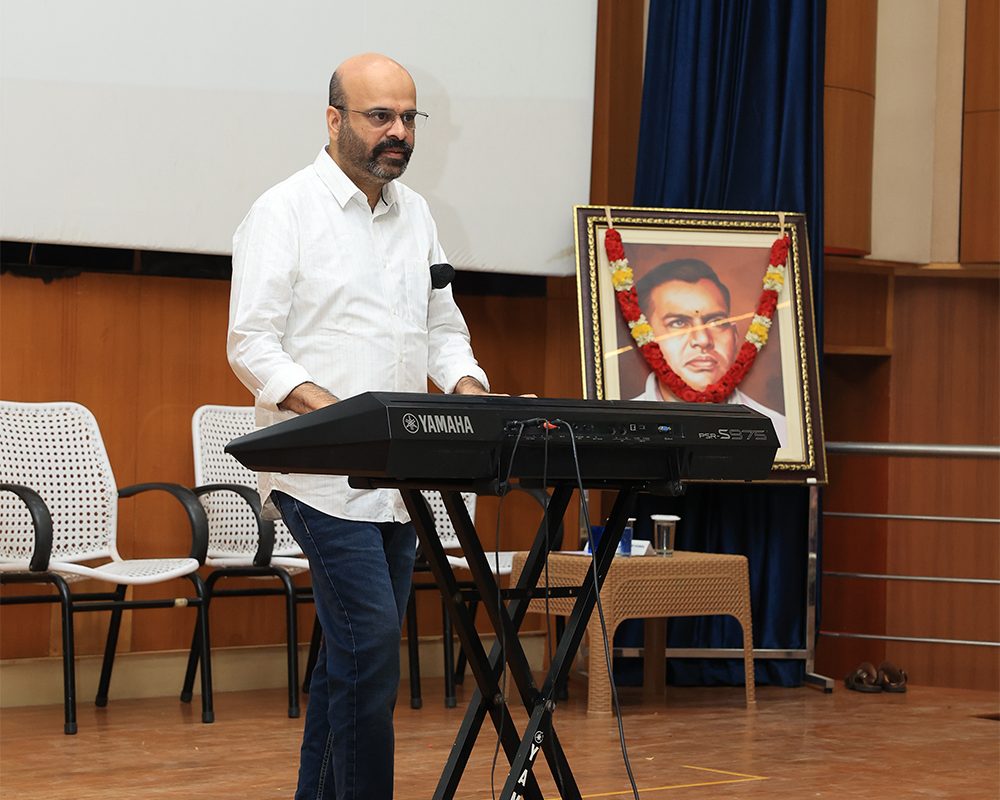
Chief Guest : Shri. Anil Srinivasan, Founder of Kruu Edtech Private Limited & Rhapsody, Kalaimamani & Sangeet Natek Akademi Awardee
The following briefing synthesizes the key themes and insights from the “Shubh Aarambh 2026” induction program at RLIMS, Madurai, featuring Shri Anil Srinivasan. The primary thesis presented is that the traditional educational landscape is undergoing a radical shift, rendering standard degrees insufficient for the future job market.Critical Takeaways:
- Modular Education: The future of professional success lies in “modular learning”—stacking specific, industry-relevant skills rather than relying solely on a fixed degree.
- AI and Data Literacy: Artificial Intelligence, defined here as “synthetic statistical inferencing,” is fundamentally altering career paths. Data literacy is no longer optional; it is a foundational skill across all specializations.
- Creativity and Neuroscience: Music and the arts are not merely cultural pursuits but tools for cognitive optimization. Music significantly increases neurotransmitter activity, enhancing a professional’s ability to recognize patterns in complex data.
- Professional Ecosystems: Success is increasingly dependent on “collaboration” rather than “competition.” A professional’s “network” is equivalent to their “net worth.”
- Resilience through Innovation: The platform “Crew” serves as a case study for identifying educational gaps in Tier 2 and Tier 3 cities and leveraging technology to democratize access to high-level academic exposure.
The Paradigm Shift: From Degrees to Modular Education
The modern professional environment is moving away from a reliance on credentials and toward “modular education.” As traditional degrees face the risk of becoming redundant within a few years, students must take an active role in shaping their own learning pathways.
- Credential Redundancy: Major global corporations (e.g., Google, PepsiCo, Coca-Cola) are increasingly prioritizing what a candidate can do and what specific problems they can solve over what degree they hold.
- Self-Directed Specialization: Students are encouraged to identify the specific industry they wish to enter and seek out online modules and certifications that supplement their formal education.
- Problem-Centric Learning: Education should be framed around the question: “What problem do you want to solve?” (e.g., pollution, healthcare accessibility, supply chain efficiency). The degree is merely a tool toward that end.
Artificial Intelligence and Career Evolution
The discourse characterizes AI not as an abstract “God-like” entity, but as a mathematical reality that professionals must master to remain relevant.
Definition and Function
AI is defined as Synthetic Statistical Inferencing . It operates by gathering vast amounts of data and statistically computing the most likely answer to a query based on synthesized information.
Impact on the Workforce
- Entry-Level Vulnerability: AI is most disruptive to entry-level positions. This necessitates that new graduates possess higher-level analytical skills from the start.
- Cross-Disciplinary Impact: Every major business function—Finance, Marketing, HR, and Analytics—is currently being reshaped by AI.
- Algorithm Bias: There is a growing need for “Algorithm Bias Auditors” to identify cultural, age, and regional biases inherent in platforms created by concentrated groups of engineers (e.g., Silicon Valley biases in global apps like Instagram).
Neuroscience and Cognitive Optimization
The induction program highlighted the intersection of music, neuroscience, and professional performance. The central argument is that exposure to music “sharpens” the brain for better data interpretation.| Stimulus Type | Neurotransmitter Activity (Signals) | Cognitive Impact || —— | —— | —— || Speech/Sentence | 30 – 35 | Medium complexity memory retention. || Music/Song | 3,75,000 | High-level engagement, improved attention, and emotional relaxation. |
Key Insight: Music helps the brain recognize patterns. A trained musical mind is better equipped to see “patterns” in marketing data or financial charts because it has been conditioned to recognize harmonic and rhythmic structures.
The 2030 Career Landscape
Citing reports from the World Economic Forum, the briefing identifies ten emerging job roles that will dominate the landscape by 2030. These roles require a blend of data science, psychology, and management.
- Cyber Calamity Forecaster: Predicting digital disasters.
- Tide Water Architect: Designing infrastructure for rising sea levels (requires environmental science and data science).
- Work From Home Facilitator: Optimizing remote professional environments.
- Smart Home Design Manager: Managing integrated home technologies.
- Fitness Commitment Counselor: Specialized health and wellness management.
- XR (Extended Reality) Immersion Counselor: Managing virtual experiences.
- Workplace Environment Architect: Designing physical and psychological office spaces.
- Algorithm Bias Auditor: Auditing AI for cultural and social fairness.
- Human-Machine Teaming Manager: Coordinating collaboration between staff and AI.
- Data Detective: Investigating and interpreting complex data sets.
Entrepreneurship and the “Crew” Model
The founding of the “Crew” platform serves as a blueprint for socially responsible entrepreneurship. The platform was inspired by the “Hole in the Wall” experiment by Professor Sugata Mitra, which proved that children in slums could teach themselves computer programming if given access to the technology.
The Success of Crew
- Reach: Currently serves 1.2 million students.
- Methodology: Moving learning away from “credentials and competition” toward “clarity, inquiry, and live academic experience.”
- Goal: Bridging the gap between students in Tier 2/3 cities and senior practitioners or university faculty.
Professional Best Practices: The “Maker” Mindset
To succeed in an increasingly complex world, the following professional “mantras” were outlined:
- Network is Net Worth: Utilizing platforms like LinkedIn is essential. Building a “Knowledge Hub” allows a professional to draw on the expertise of thousands of others.
- Collaboration over Competition: The “first rank” mentality of traditional schooling does not work in the workplace. Success requires working with diverse teams, including those one may personally dislike.
- Rest Space: Cognitive performance requires deliberate rest. Professionals are encouraged to take 30-second “rest spaces”—closing one’s eyes and thinking of a supportive figure—to trigger physiological relaxation and mental clarity.
- Fidelity to Purpose: Resilience is developed by responding to adversity with innovation. The speaker’s personal experience of overcoming a multi-organ failure and a stroke to launch a successful startup illustrates that “difficulty is for everyone; how you respond is up to you.”
Notable Quotes
“Education should prepare people not just to earn, but to think responsibly in an increasingly complex world.””Your network is your net worth.””AI is not God; it is Synthetic Statistical Inferencing… if you don’t use AI, AI will use you.””Degrees will become redundant; your ability to solve problems will not.”